Address
304 North Cardinal
St. Dorchester Center, MA 02124
Work Hours
Monday to Friday: 7AM - 7PM
Weekend: 10AM - 5PM
Address
304 North Cardinal
St. Dorchester Center, MA 02124
Work Hours
Monday to Friday: 7AM - 7PM
Weekend: 10AM - 5PM

A practical guide to ship chickpeas for export: storage, moisture control, packaging and documentation for reliable UAE wholesale shipments.
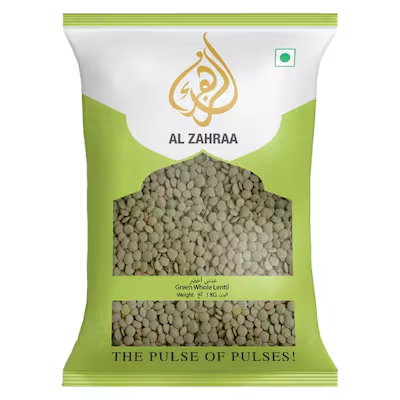
A field-tested guide to help wholesale buyers and traders ship chickpeas for export with confidence — protecting quality from warehouse to destination port.
When you plan to ship chickpeas for export, the difference between a profitable shipment and a costly claim usually comes down to three things: how the product is stored, how it is packed, and how the paperwork is prepared. Chickpeas are a hardy pulse, but they are still a living agricultural product that reacts to moisture, heat and pests during long ocean transits. At AgroFoods Global, our wholesale and export team handles these details every day, and this guide shares the practical fundamentals that keep cargo arriving clean, dry and saleable.
Good export shipments begin long before the container is booked. Chickpeas should be stored in a cool, dry, well-ventilated warehouse away from direct sunlight and any source of dampness. The single most important factor is moisture content. Pulses held at too high a moisture level are prone to mould, caking and insect activity, while properly conditioned stock stays stable for months.
Buyers in different markets expect a consistent product, so cleaning and grading are essential. Removing dust, stones, broken seeds and foreign matter improves both appearance and shelf life. Where required, fumigation or controlled treatment is carried out under professional supervision before sealing, so that the cargo meets the importing country’s plant-health expectations. Conditioning at this stage also reduces the risk of pest issues developing inside a sealed container.
Packaging protects your margin. The most common formats for bulk pulses are woven polypropylene bags and multi-wall paper sacks, typically in 25 kg or 50 kg units, with smaller retail packs available on request. The packaging must be strong enough to survive repeated handling, breathable enough to avoid trapped condensation, and clearly marked for traceability.
Even perfectly packed chickpeas can be damaged by a poorly loaded container. Containers should be inspected for cleanliness, odours and water damage before stuffing. Cargo must be evenly distributed and braced so it cannot shift during sea transit. Because temperature swings between a hot port and a cold ocean crossing create condensation — often called container rain — ventilation and moisture-absorbing materials are key to keeping bags dry on arrival.
Documentation is where many first-time exporters stumble. Each destination has its own import requirements, and missing or incorrect papers can hold a shipment at the port. A typical pulse export file includes a commercial invoice, packing list, bill of lading, certificate of origin and, in many cases, a phytosanitary certificate confirming the goods are pest-free. Working with an experienced supplier reduces the risk of delays, demurrage and rejected loads. Our team prepares export paperwork as part of every order and can advise on the specifics for your market on request.
Quick answers to the questions wholesale buyers ask most when shipping pulses internationally.
Properly dried and stored chickpeas can be held for many months without significant quality loss. The key is stable low humidity, good ventilation and regular pest monitoring. Stock should still be rotated so older inventory ships first.
Woven polypropylene or multi-wall paper bags in 25 kg or 50 kg units are the most common for bulk pulses. The right choice depends on your market, handling conditions and whether the buyer wants palletised or loose-loaded cargo. We confirm the format with you before packing.
Many importing countries require a phytosanitary certificate to confirm the consignment is free of pests and disease. Requirements vary by destination, so it is best to confirm the exact documents for your market; our export team can guide you on what each shipment needs.
From storage and grading to packaging and export documents, AgroFoods Global supports wholesale buyers and traders end to end. Tell us your destination and volumes and we will tailor a quote.
Request an Export Quote Wholesale & ExportExplore more in our food grains range, browse the full online shop, or read practical answers in our resources and FAQ.
AgroFoods Global sources and consolidates How to Store, Pack & Ship Chickpeas for Export for bulk buyers worldwide from our Dubai, United Arab Emirates trading hub. As an established food export house, we aggregate demand across importers and cash-and-carry buyers and wholesale distributors, then ship consolidated or full-container loads under flexible Incoterms. Buyers sourcing how to store, pack & ship chickpeas for export at wholesale volumes benefit from the UAE’s re-export ecosystem: duty-free zones, world-class port infrastructure at Jebel Ali, and trade lanes that reach the Levant and North Africa and the GCC within days.
Whether you are a first-time importer testing a mixed pallet or an established distributor placing repeat monthly containers, our trade desk structures pricing to your order profile. We keep sourcing lines diversified so supply stays reliable through seasonal swings and freight-market volatility.
Minimum order quantities for How to Store, Pack & Ship Chickpeas for Export typically start at 50 cartons and scale to full 20ft and 40ft containers. Because we consolidate multiple SKUs into a single shipment, smaller buyers can still reach economical container economics by combining how to store, pack & ship chickpeas for export with other grocery lines from our catalogue.
| Order tier | Typical use case | Pricing basis |
| Mixed pallet | Trial / small retailer | List wholesale |
| Full pallet(s) | Regional distributor | Volume tier 1 |
| LCL consolidation | Multi-SKU importer | Volume tier 2 |
| FCL 20ft / 40ft | National wholesaler | Best contract price |
Repeat-order and annual-contract buyers receive the sharpest how to store, pack & ship chickpeas for export pricing. Send your target quantity and destination and our team returns a landed-cost quotation within one business day.
Every how to store, pack & ship chickpeas for export shipment leaves the UAE with complete export documentation: commercial invoice, packing list, certificate of origin, and — where the product and destination require it — health certificates, halal certification and phytosanitary paperwork. We ship under EXW Dubai, FOB Jebel Ali and other agreed Incoterms, and coordinate with freight forwarders for ambient and chilled logistics as the product demands.
Demand for How to Store, Pack & Ship Chickpeas for Export in international wholesale channels continues to be shaped by population growth, urbanisation and the expansion of organised retail across emerging markets. Importers in Europe and the CIS, the Levant and North Africa and the GCC are increasingly sourcing through the United Arab Emirates because Dubai combines competitive landed cost, deep supplier networks and unmatched re-export logistics. For distributors, the strategic question is no longer simply where to buy how to store, pack & ship chickpeas for export, but how to secure consistent quality, predictable lead times and pricing that holds up across a full purchasing year.
AgroFoods Global sits at the centre of that flow. We aggregate wholesale demand for how to store, pack & ship chickpeas for export from importers and cash-and-carry buyers, supermarket chains and HORECA operators, then convert it into consolidated container shipments that reach destination ports quickly and cost-effectively. That scale is what lets a mid-sized importer buy at pricing normally reserved for national chains.
Landed cost for How to Store, Pack & Ship Chickpeas for Export is the sum of several moving parts, and understanding them helps buyers negotiate from a position of knowledge rather than guesswork. The largest drivers are raw-product cost at origin, packaging format, order volume, freight rates on your trade lane, and the Incoterm you choose. Currency movements and seasonal supply also play a role.
Our trade desk breaks every how to store, pack & ship chickpeas for export quotation down transparently so you can see exactly where the landed cost comes from and where volume or format changes can improve it.
Reliable wholesale supply of How to Store, Pack & Ship Chickpeas for Export depends on disciplined supplier vetting. AgroFoods Global works with manufacturers and packers whose food-safety credentials, hygiene practices and documentation withstand importer and customs scrutiny. Before a how to store, pack & ship chickpeas for export line enters our catalogue we confirm specifications, verify certifications appropriate to the product, and check that packaging survives real-world ocean transit. This upstream diligence protects your brand and your clearance timeline.
For buyers, that means fewer rejected shipments, cleaner customs clearance and a product that arrives in the condition your customers expect. Consistency, not just price, is what turns a one-off order into a long-term supply relationship.
We help buyers sidestep each of these. Send us your target market and volume and we will structure the how to store, pack & ship chickpeas for export order to be compliant, economical and continuously supplied.
Wholesale appetite for How to Store, Pack & Ship Chickpeas for Export varies by region, and matching supply to that demand is where distributors win share. In Europe and the CIS, buyers prioritise trusted documentation and certification; in the GCC, expanding foodservice and hospitality drives volume. Because AgroFoods Global ships from a single UAE hub to all of these markets, we can serve a distributor operating across several countries from one consolidated supply relationship.
This regional reach also gives buyers flexibility: as your how to store, pack & ship chickpeas for export programme grows into new territories, your supply line grows with it — no need to re-source or re-qualify a new vendor in every market.
AgroFoods Global works with buyers on the trade terms that suit their business, from single spot orders to annual supply contracts for How to Store, Pack & Ship Chickpeas for Export. We quote under EXW Dubai, DAP and CIF destination port, and can align documentation to letter-of-credit, TT and other agreed payment structures. Contract buyers gain price stability and priority allocation during tight-supply periods — an advantage that pure spot buyers do not have.
Responsible sourcing matters increasingly to retail and foodservice buyers of How to Store, Pack & Ship Chickpeas for Export. AgroFoods Global favours suppliers with sound food-safety systems and transparent origin, and we structure logistics to move how to store, pack & ship chickpeas for export efficiently — consolidation and full-container loading reduce per-unit freight and packaging waste. For buyers who need it, we can support the documentation trail that underpins responsible-sourcing and traceability claims in your market.
AgroFoods Global regularly ships How to Store, Pack & Ship Chickpeas for Export to buyers across the GCC & Middle East. Importers there choose UAE-consolidated supply for its blend of competitive landed cost, reliable documentation and fast transit from Jebel Ali. We tailor pack formats, labelling and Incoterms to the requirements of the GCC & Middle East, and consolidate how to store, pack & ship chickpeas for export with complementary grocery lines so even mid-volume buyers achieve full-container economics. Whether you serve modern-trade retail, wholesale or foodservice in the GCC & Middle East, our trade desk builds a supply plan that keeps your shelves stocked and your margins protected.
Typical MOQ starts at 50 cartons; we consolidate multiple SKUs to reach economical container volumes for smaller buyers.
We ship how to store, pack & ship chickpeas for export worldwide from Jebel Ali, Dubai — regularly serving Europe and the CIS, the Levant and North Africa and the GCC under FOB, CIF and CFR terms.
Yes — commercial invoice, packing list, certificate of origin, and health/halal certificates where applicable, aligned to your destination and banking requirements.
Send your quantity and destination port via our contact page; our trade desk responds with a landed-cost quotation within 24 hours.
AgroFoods Global is your UAE partner for bulk How to Store, Pack & Ship Chickpeas for Export supply and export. Contact our trade desk for pricing, samples and shipping schedules, browse the full wholesale catalogue, or explore our wholesale shop.